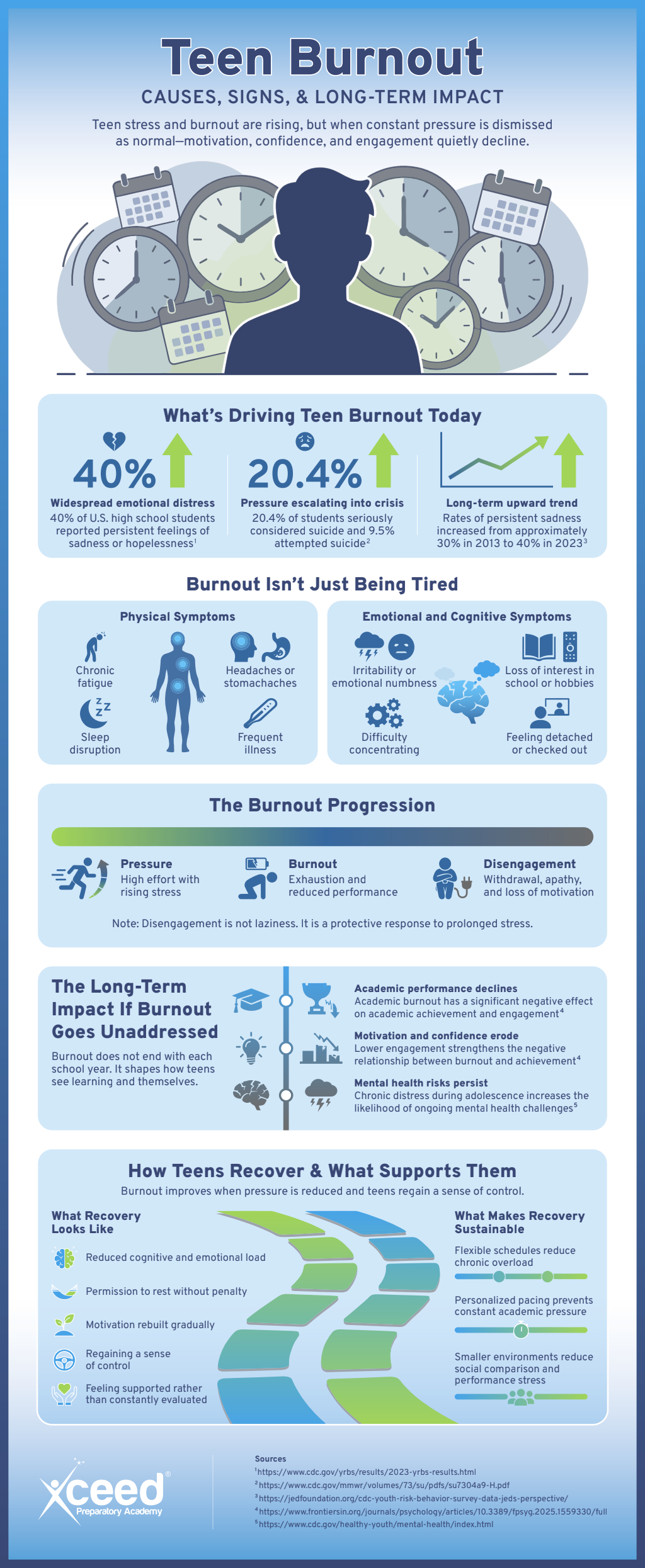
Teen burnout is often mistaken for a lack of effort, motivation, or resilience. In reality, burnout is a signal that something in the learning environment is no longer working for the student. It reflects a mismatch between expectations and capacity, structure and autonomy, pressure, and recovery.
For many teens, school demands extend far beyond academics. Long days, constant evaluation, social comparison, and limited control over pacing can turn even motivated students into disengaged ones. When every task feels urgent and every outcome feels high stakes, stress stops being productive and starts becoming corrosive.
Burnout also looks different from student to student. Some teens become visibly exhausted or irritable. Others grow quieter, disconnected, or emotionally flat. These changes are often subtle at first, which is why they are easy to dismiss as typical teenage behavior. Over time, however, chronic stress can reshape how students relate to learning itself. Curiosity gives way to avoidance. Confidence erodes. Effort begins to feel pointless.
The Hidden Role of Rigid Learning Structures
One overlooked contributor to burnout is the lack of flexibility in traditional learning structures. Teens vary widely in how they process information, manage energy, and respond to pressure. Students with IEP accommodations may face added challenges when supports are inconsistently applied or when learning environments are not designed with flexibility in mind. Even students without formal accommodations can struggle when instruction moves at a fixed pace or prioritizes output over understanding.
This is where flexible learning and personalized learning at a private school approaches can play a meaningful role. When students have more agency over pacing, workload, and how they demonstrate understanding, stress becomes more manageable. Blended learning environments can also help by allowing students to engage with material in different ways, balancing independent work with guided support.
Restoring Balance Without Lowering Standards
Recovery from burnout is not about lowering expectations or removing challenge. It is about restoring balance. Teens need time to rest without feeling like they are falling behind. They need environments where asking for help is normalized rather than penalized. Most importantly, they need to feel seen as individuals rather than as averages or benchmarks.
Supportive learning environments recognize that growth is not linear. Motivation often returns gradually once students feel safe, capable, and in control of their learning experience. Smaller settings, consistent relationships, and intentional pacing can help rebuild trust between students and school.
Burnout is not a personal failure. It is feedback. When educators and families listen to that feedback, they can create conditions where teens are challenged, supported, and able to reengage with learning in healthier ways.