

If you want a story-driven game that turns daily math practice into something your child asks to play, MathHero (ages 5 to 10) is our top pick for core arithmetic: addition, subtraction, times tables and division. For the earliest numbers and counting, Khan Academy Kids (ages 2 to 8) is hard to beat, and it is free. For older kids who want a bigger game world across more grades, try Prodigy Math (grades 1 to 8), and for puzzle-style topics past arithmetic there is DragonBox. Whatever you choose, check the ads, the real price, and whether your child is actively thinking, not just tapping.
We judged every app with the same checklist, and we only list facts we could confirm on each app’s own website or store page. Last checked: October 2026.
How we judge the apps?
There is no official rating for educational apps, and the number of apps labeled “educational” far outruns anyone’s ability to test them. So we leaned on two trusted sources.
- The four pillars of learning. In a 2015 research review, psychologist Kathy Hirsh-Pasek and colleagues found that children learn best when they are actively involved (thinking and choosing, not just tapping), engaged (focused, not distracted by extras), making meaning (connecting it to what they already know), and socially interactive (talking about it with others).
- Pediatric advice on media. The American Academy of Pediatrics suggests families choose apps that teach and avoid content heavy with ads.
From there, we checked each app for age fit, ads, a clear price, and privacy.
Quick comparison
| App | Ages | Math covered | Price | Ads |
| MathHero | 5 to 10 | Addition, subtraction, times tables, division (K to 4) | Free at 5 levels a day; optional subscription lifts the cap | None |
| Khan Academy Kids | 2 to 8 | Early math plus reading and more | Free | None (stated by the app) |
| Prodigy Math | Grades 1 to 8 | Grade-level math in a game | Free to play; optional membership | Check listing |
| DragonBox (Kahoot!) | 4 to 8, and 8+ | Numbers, times tables, and topics beyond arithmetic | Kahoot!+ subscription | Check listing |
| SplashLearn | Preschool to grade 5 | Math and reading | Check current plans | Check listing |
| Moose Math | 3 to 7 | Early math | Free | None (App Store listing) |
“Check listing” means we could not confirm it on the official page. Look at the store listing before you install.
The math apps, one by one
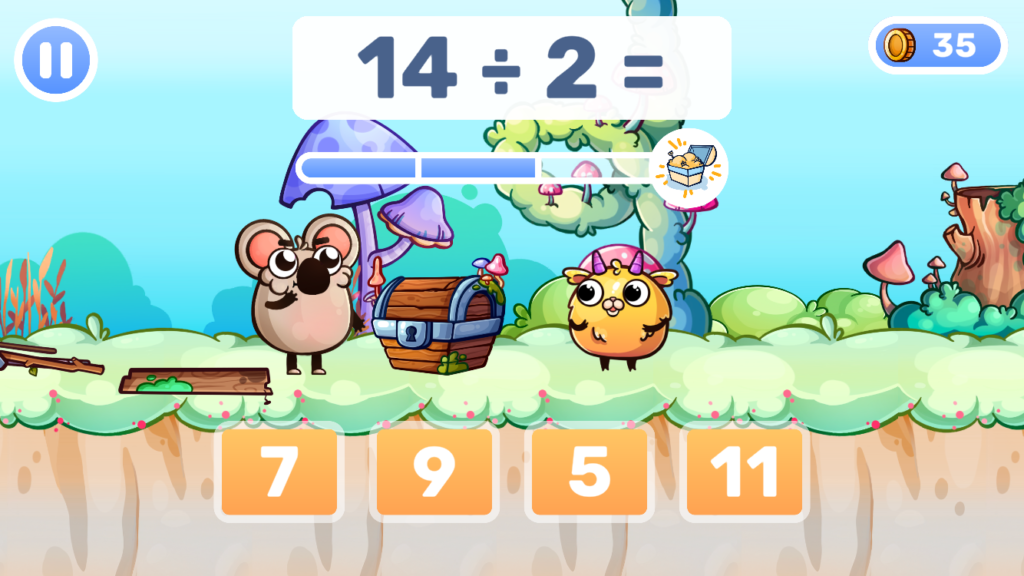
MathHero: Best for turning daily practice into a game kids ask to play
Start here if your child needs to get faster and more confident with arithmetic and tends to resist practice. MathHero is a story-driven game for ages 5 to 10 (grades K to 4) where solving math facts is how you play. Your child frees trapped characters, fixes race cars and battles monsters, and every correct answer is what moves the story forward. A wrong answer costs a moment, not a lecture, so kids keep trying. That is why the thing parents repeat most in reviews is that their child does not notice they are practicing. Parents of kids who used to dread math often describe them asking to play within a day or two.
It covers the full core path: addition and subtraction within 10, 20, 100 and 1000, the times tables, and division. What parents single out is the control. A parent picks a guided step-by-step program or sets up custom practice: turn each operation on or off, choose individual times tables (only the 7s and 9s, for example), set the number range and difficulty, and switch between typed answers and multiple choice. Each child profile keeps its own settings and progress, so siblings at different levels can share one game.
- Best for: kids 5 to 10 who already know their numbers and need steady, low-stress practice in addition, subtraction, multiplication or division.
- Privacy: no ads, no chat, no account to create, and purchases sit behind a parent gate. It works offline after download and has 27 languages.
- Price: free at five levels a day, and that free plan is the whole game, not a demo, with nothing locked. A subscription with a 7-day free trial removes the daily limit. Five levels is a reasonable amount for one short session, so plenty of families stay on the free plan.
- Ratings: Google Play 4.7 (48.2K reviews) and App Store 4.6 (12K ratings), checked October 2026.
- Know this: MathHero starts at first addition within 10, so it is not for a child still learning to count, and it stays on arithmetic (no fractions, geometry or equations). The timed monster battles can feel intense for some five-year-olds; the Easy mode and multiple choice calm it down. New levels do not always arrive quickly, so a child who races ahead may replay content while waiting for more. (One word, MathHero, made by SpeedyMind. Check the developer name so you do not pick a similarly named app.)
Khan Academy Kids: best free all-rounder
Khan Academy Kids is for ages 2 to 8 and covers early math alongside reading and other first skills. Its App Store page describes it as free with no ads and no subscriptions. It runs on iPad, and it is also on Google Play and the Amazon Appstore.
- Best for: families who want one free app covering many early subjects.
- Know this: math is one part of a larger app, so there is less depth for older kids who need focused times-tables practice.
Prodigy Math: a bigger game world for older kids
Prodigy Math is the closest thing on this list to MathHero in spirit: a fantasy adventure where kids answer math questions to progress. It spans grades 1 to 8 and covers more topics than arithmetic. According to Prodigy, the math questions are free, with an optional paid membership adding extras. Where MathHero keeps a tight focus on core arithmetic for ages 5 to 10 with parent-chosen practice, Prodigy casts a wider net across grades and topics.
- Best for: kids about 7 and up who love role-playing games.
- Know this: the game world is a big part of the draw, so check your child is answering questions, not only exploring. Membership prices change, so confirm the current cost before you subscribe.
DragonBox: puzzle-style math, including topics beyond arithmetic
The DragonBox apps are now part of Kahoot!. DragonBox Numbers is aimed at ages 4 to 8 and DragonBox Multiplication at ages 8 and up, and the wider range reaches into fractions and algebra. Both come with a Kahoot!+ subscription.
- Best for: kids who like visual puzzle games and are ready for topics past basic arithmetic.
- Know this: you pay through a Kahoot!+ subscription, not a one-off purchase. Check the current listing before you install.
SplashLearn: math and reading by grade
SplashLearn covers preschool up to grade 5 in both math and reading, tied to school grades, and works on the web, iOS and Android. It sits alongside an app like MathHero rather than replacing it: broad curriculum coverage on one side, fast arithmetic practice on the other.
- Best for: families who want curriculum-aligned lessons mapped to school grades.
- Know this: confirm the current plans on its site before you subscribe.
Moose Math: a free start for little ones
Moose Math comes from Duck Duck Moose, part of Khan Academy. Its App Store listing gives ages 3 to 7 and lists it as free.
- Best for: preschoolers and kindergartners taking their first steps in counting.
- Know this: it is built for the very start of school, so older kids outgrow it quickly. Once your child is ready for first addition, an arithmetic game like MathHero is the natural next step.
Free vs paid: what “free” usually means
“Free” can mean very different things, so know which one you are getting before your child gets attached:
- Fully free: everything is free with no ads (Khan Academy Kids describes itself this way).
- Free with ads: you pay with your child’s attention, and ads can pull kids out of the app.
- Free with a daily limit: the whole game is open with nothing locked, but there is a cap on how much you can play each day (MathHero works this way, at five levels a day; a subscription lifts the cap).
- Free start: some content is free and the rest needs a subscription.
- Free trial: everything is open for a short time, then you pay.
None of these is wrong. Just know which one applies.
How much screen time is OK?
There is no single right number for every family. The American Academy of Pediatrics suggests making a family media plan: choose quality apps, keep some times and places screen-free such as meals and bedtime, and use media together when you can. A good math app works best as a short, regular top-up, not a replacement for hands-on play and time with you.
Our advice by age
Ages 2 to 5: start free with Khan Academy Kids or Moose Math for counting and first numbers. Keep sessions short and structured.
Ages 5 to 7: pick an app that drills adding and subtracting in short rounds, and check the ads policy. This is where MathHero fits for most kids: it starts at first addition within 10 and keeps practice to a few minutes a day.
Ages 7 to 10: times tables need regular recall practice. MathHero’s multiplication games, DragonBox Multiplication and Prodigy all give that kind of repeated practice. Pair any app with a little offline practice, and watch for gaps in the tables early.
Questions parents ask
What is the best math app for a child who hates math? An app where solving the problem is the game itself, like MathHero, tends to work better than drills with rewards bolted on top. Many parents report their child going from resisting practice to asking to play within a day or two. It is not a cure, and every child is different, but it lowers the friction.
Are there free math apps with no ads? Yes, though they are less common than you would hope. Khan Academy Kids describes itself as fully free with no ads. MathHero is free at five levels a day with no ads, and the whole game is open on the free plan.
Do math apps work offline? Some do, especially for basic practice. MathHero is fully playable offline after download. Others need a connection for progress tracking or new lessons, so check the listing.
How can I tell if an app really teaches? Look for apps that build skills step by step, give feedback, and adjust difficulty by performance rather than rewarding fast tapping. A game where answering the problem is the action keeps a child thinking, instead of exploring a world where the math is optional.
Should a math app match the school curriculum? Not always, but it helps when the app lines up with what your child is learning. SplashLearn and similar tools follow a grade-based curriculum; an app like MathHero is built for fast, reliable recall of core arithmetic, which supports school work without copying it.
Whatever you choose, sit with your child for the first few sessions. You will learn more from ten minutes of watching than from any guide, including this one.


